
The United States is one of only two countries in the world with a for-profit bail system (the Philippines is the other).
There are two primary forms of bail: bail bonds that are paid to private companies, and cash bail that is paid to the courts themselves. Cash bail isn’t well known to the general public, but it’s an outrageous abuse of the criminal justice system — and one we’re determined to stop.
Here’s how cash bail works.
People who have been arrested in Minnesota — regardless of how minor the alleged offense — are brought before judges who unilaterally set the bail amount that they’ll have to pay to be released until their trials begin.
If they can’t afford to pay the full amount, they can’t leave, even if staying in jail means they’ll lose their jobs or be separated from family or friends who depend on them.
That can mean being held in jail for weeks, months or even years until their trials begin. In Minnesota alone, more than 60% of those incarcerated are being held in pre-trial detention.
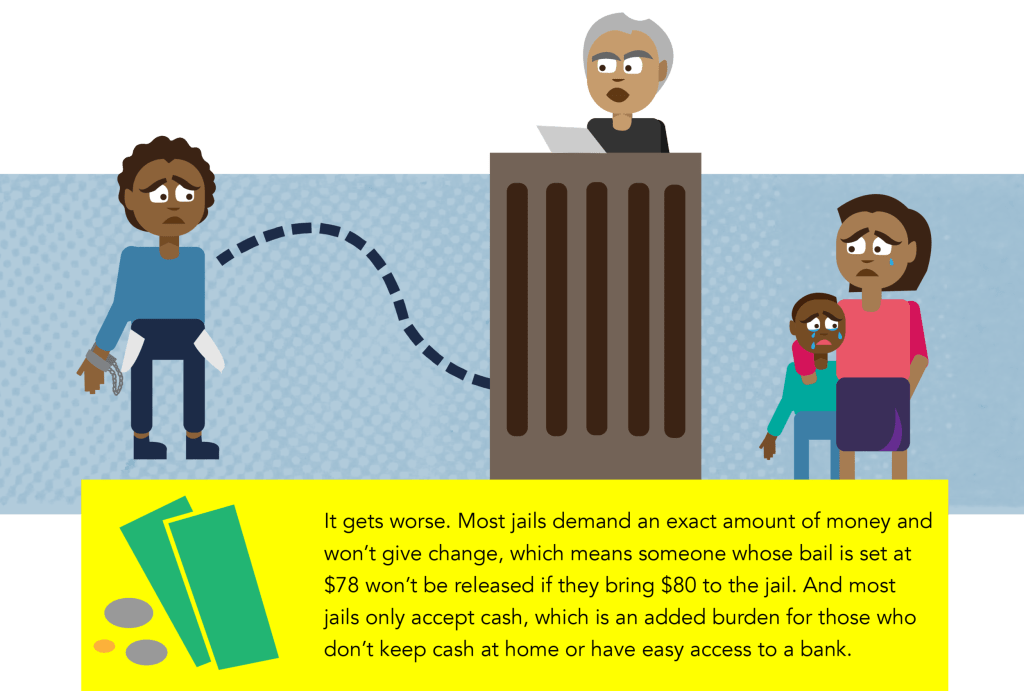
The bail money is returned once a person shows up for their trial, but courts may keep some of the money as a processing fee, dealing yet another blow to people struggling to make ends meet.
Why is cash bail such a problem?
Putting it bluntly, cash bail is an abusive system that criminalizes poverty and takes a disproportionate toll on Black people, Indigenous people, and people of color. It doesn’t matter whether you are guilty or innocent — if you cannot afford to post your bail, you will stay in jail until your trial.
Not only is this unfair, it can have disastrous effects on people’s lives in the long term. Spending even just a few days in jail can result in losing a job, housing, or even custody of children.
Cash bail also has stark racial disparities. Studies show that judges are more likely to assign bail to Black defendants, and set higher amounts for similar crimes when compared to white defendants. Additionally, the racial wealth gap makes it more likely that defendants of color will not have immediate access to the cash needed to post bail — and the numbers show it.
In Minnesota, Black people comprise 7% of the state population, but 31% of the prison and jail population. Indigenous people account for 1% of Minnesota’s population, but eight percent of the prison and jail population.

Not only is cash bail harmful to our communities, it’s also a burden on state resources that could be used for public health, transportation and other essential services that would help end the cycle of mass incarceration. Holding people in pre-trial detention for low-level alleged offenses, before they’ve even been proven guilty, is incredibly expensive for taxpayers.
Moreover, there is very little evidence that posting bail makes it more likely people will appear in court, meaning that the cash bail system deals devastating blows to families, communities, and taxpayers, with virtually no benefit to public safety.
In New Jersey and Washington, DC, where cash bail has been all but abolished, over 90% of defendants appeared for their court dates — a higher figure than had shown up while the cash bail system was still in place.